Advanced Hip Replacement Centre

Hip Replacement — Walk Without Pain. Live Without Limits.

Advanced hip replacement surgery in Ahmedabad using minimally invasive techniques with smaller incisions, less muscle damage and faster recovery. Most patients walk within 24 hours and go home in 3 to 4 days. Implant systems are designed to last 20 to 25 years with proper care.

1000+
Surgeries Done
100%
Success Rate
10+
Years Exp.
24/7
Emergency
Insurance Accepted
Specialist Team

Book A Consultation

Our specialist will call you within 2 hours
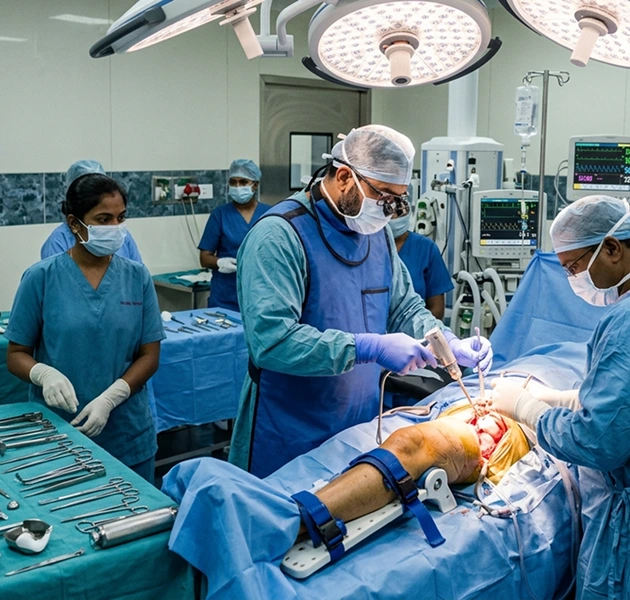
    HIP Replacement at Trayam Hospital
    What is Hip Replacement Surgery?

    Understanding Total Hip Replacement

    Total hip replacement, also called total hip arthroplasty, is a widely performed hip replacement surgery in Ahmedabad where the damaged ball and socket joint is replaced with an artificial implant designed to restore smooth and pain-free movement. The worn femoral head (ball) is removed and replaced with a metal or ceramic stem and ball; the damaged acetabulum (socket) is resurfaced with a metal cup and liner. The result is a smooth, pain-free joint that functions like a healthy hip — restoring mobility, eliminating arthritis pain and allowing patients to return to an active life.

    At Trayam Hospital, every hip replacement surgeon focuses on minimally invasive surgical techniques using a single incision of 8 to 10 cm instead of the larger incision used in traditional surgery. This approach reduces tissue damage, supports faster recovery and helps patients return to daily life with greater confidence. This approach spares the surrounding muscles, reduces blood loss and significantly accelerates recovery. Most patients walk with assistance within 24 hours of surgery, are discharged in 3–4 days and return to full daily activities within 6–8 weeks. Implant systems are selected individually, ceramic-on-ceramic, metal-on-polyethylene or cementless press-fit, based on age, activity level and bone quality.

    • Total joint reconstruction — worn femoral head and acetabular socket both replaced with precision implants
    • Minimally invasive approach — 8–10cm incision, muscle-sparing technique, reduced blood loss
    • Walk within 24 hours — physiotherapy begins same day as surgery
    • Implant lifespan 20–25 years — with appropriate activity and annual follow-up
    • Implant choice tailored to you — ceramic, cementless or cemented based on age, bone quality and lifestyle
    Do You Need It?

    Signs You May Need HIP Replacement

    If you're experiencing any of these symptoms, a consultation with our specialist is recommended

    Chronic HIP or Groin Pain

    Chronic HIP or Groin Pain

    Deep pain in the HIP, groin or upper thigh — present at rest, at night and during activity. Often described as a dull ache that occasionally becomes sharp with movement. Pain in the groin that radiates to the knee is the classic pattern of HIP joint disease.

    Limp or Altered Gait

    Limp or Altered Gait

    A noticeable limp caused by the body subconsciously offloading the painful HIP. Gait changes put abnormal stress on the knee, lower back and opposite HIP — causing secondary problems that worsen over time without treatment.

    Difficulty Rising from a Seat

    Difficulty Rising from a Seat

    Pain and stiffness when standing up from a chair, low seat or car — a reliable early sign of HIP joint deterioration. The HIP lacks the range of motion and strength to push through the transition from sitting to standing without pain.

    Difficulty with Shoes and Socks

    Difficulty with Shoes and Socks

    Inability to bend the HIP sufficiently to put on shoes, socks or cut toenails on the affected side — a functional limitation that directly reflects loss of HIP flexion and internal rotation.
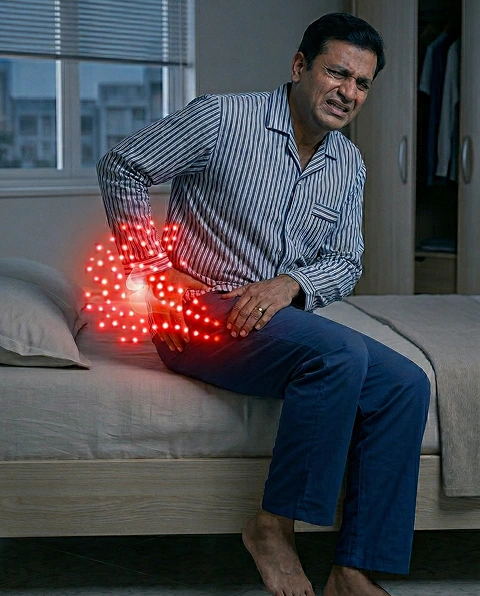
    Night Pain — Disturbed Sleep

    Night Pain — Disturbed Sleep

    HIP pain that wakes you at night or makes it difficult to find a comfortable sleeping position. Night pain indicates advanced joint disease — cartilage has been lost to the point where even the resting position causes bone-on-bone contact and discomfort.

    Failed Conservative Treatment

    Failed Conservative Treatment

    Pain that no longer responds adequately to anti-inflammatory medication, physiotherapy, walking aids or steroid injections — despite 3–6 months of consistent treatment. When conservative management is exhausted, surgery becomes the appropriate next step.

    Severe Arthritis on X-Ray / AVN

    Severe Arthritis on X-Ray / AVN

    X-ray showing complete or near-complete loss of joint space, bone-on-bone contact, osteophytes or avascular necrosis (AVN) — collapse of the femoral head due to loss of blood supply. AVN is a specific indication for HIP replacement before total femoral head collapse occurs.

    Loss of Active Lifestyle

    Loss of Active Lifestyle

    Inability to walk comfortable distances, climb stairs, use public transport or maintain independence in daily activities because of HIP pain — in a patient who is otherwise medically fit. Quality of life impairment is a legitimate and important indication for surgical treatment.

    Why Trayam

    Leading Centre for Hip Replacement Surgery in Ahmedabad

    Thousands of patients have trusted our team of hip replacement surgeons for safe, successful outcomes with consistent long-term results.

    1000+
    HIP Replacements
    100%
    Patient Satisfaction
    10+
    Years Experience
    24/7
    Emergency

    Robotic-Assisted Precision

    State-of-the-art robotic technology ensures precise cup placement and leg length restoration — the two most critical technical factors in HIP replacement outcomes. Robotic guidance reduces the risk of cup malpositioning, dislocation and leg length discrepancy that are associated with conventional freehand technique.

    Minimally Invasive — Muscle Sparing

    Our HIP replacements use a minimally invasive, muscle-sparing approach — preserving the short external rotator muscles that are cut in traditional surgery. Less muscle damage means less post-operative pain, lower dislocation risk and significantly faster return to walking.

    Expert Surgical Team

    Highly experienced joint replacement surgeons with international training and thousands of successful HIP replacement cases. Surgical volume and experience directly predict outcomes in HIP replacement — we have both.

    Zero-Infection Protocol

    Strict sterile laminar flow OT environment, NABL-accredited pre-operative screening, antibiotic prophylaxis and proven wound care protocols. HIP replacement infection is devastating — our protocols are designed to eliminate the risk.

    Implant Choice — Matched to You

    We offer the full range of HIP implant options — ceramic-on-ceramic (lowest wear, ideal for younger patients), cementless press-fit (bone ingrowth, longest fixation), cemented (optimal for osteoporotic bone in older patients) and hybrid. The right implant for your age, activity level and bone quality — not a single system for every patient.

    In-house Physiotherapy from Day 1

    Dedicated rehabilitation team begins HIP replacement physiotherapy within 24 hours of surgery. A structured protocol — HIP precautions, assisted walking, strengthening and return to activity — maximises speed and quality of recovery and minimises the risk of dislocation in the early post-operative period.

    Expert Care

    Meet Your HIP Replacement Specialist

    Dr. Parth Patel — Trayam Hospital
    MS Orthopaedics Fellowship – Joint Replacement 10+ Yrs Exp.

    Dr. Parth Patel

    Senior Consultant — Joint Replacement & Orthopaedics

    Dr. Parth Patel is one of India's most trusted HIP and knee replacement surgeons, with over 10 years of experience and 1,000+ successful HIP replacement procedures. Trained at renowned institutions in India and abroad, Dr. Parth Patel specialises in minimally invasive and robotic-assisted total HIP replacement — delivering consistent outcomes with the fastest possible patient recovery. A particular focus on avascular necrosis of the HIP and revision HIP replacement in younger, active patients.

    • MS Orthopaedics — B.J. Medical College Ahmedabad
    • Spine Fellowship (Indian Spinal Injury Centre, Delhi), Endoscopic Spine Fellowship (Asian Spine Hospital, Hyderabad), and Joint Replacement Fellowship under Dr. H. P. Bhalodiya at Saviour Hospital.
    • Mission: Clear diagnosis, clean surgery, and steady recovery for every patient.
    Procedures We Offer

    Types of HIP Replacement

    Our orthopaedic team offers the full range of hip replacement surgery options, with implant choice and technique carefully selected based on your age, activity level and bone quality.

    Cementless Total HIP Replacement

    The implant is press-fitted directly into the prepared bone — no bone cement used. The surface is coated to encourage bone to grow into the implant over 6–8 weeks, providing the most durable long-term fixation. Ideal for patients under 70 with good bone quality. Most commonly performed HIP replacement technique globally.

    Most Common

    Ceramic-on-Ceramic HIP Replacement

    Both the ball and socket liner are made of high-grade alumina ceramic — the lowest wear bearing surface available. Ideal for active patients under 60 who need the implant to last 25–30 years. Produces no metal or polyethylene debris — eliminating the wear-related loosening associated with older bearing surfaces.

    Younger Patients

    Cemented Total HIP Replacement

    Bone cement (PMMA) is used to fix the femoral stem and/or acetabular cup in place — providing immediate stable fixation without relying on bone ingrowth. Preferred in patients over 75 or those with osteoporotic bone where press-fit fixation may not be reliable. Allows full weight-bearing from day one.

    Older Patients

    Hemiarthroplasty (Partial HIP Replacement)

    Only the femoral head (ball) is replaced — the natural acetabular socket is left intact. Primarily used for displaced femoral neck fractures in elderly patients and selected cases of avascular necrosis confined to the femoral head. Shorter operative time with a reliable outcome for appropriate indications.

    AVN / Fracture
    What to Expect

    Your Recovery Journey After HIP Replacement

    A step-by-step guide to your recovery after HIP Replacement at Trayam Hospital.

    Day 1

    Surgery completed. Physiotherapy begins within hours. First assisted walk with a walking frame. HIP precautions explained — positions to avoid in first 6 weeks.

    Day 3–4

    Discharged home. Walking with a walker. Pain well-controlled with oral medication. Wound care instructions provided. Follow-up appointment scheduled.

    Week 2

    Sutures or staples removed at outpatient review. Swelling and bruising reducing. Home exercises progressing. Transition from walker to elbow crutch for many patients.

    Week 6

    Walking unaided for most patients. HIP precaution restrictions lifted at 6-week review. Driving discussed. Outpatient physiotherapy progressing to strength and balance.

    Month 3

    Most daily activities fully resumed. Return to light work and recreational activity. Stair climbing comfortable. Significant reduction in pre-operative pain levels.

    Month 6–12

    Full recovery — return to swimming, cycling, golf and normal life activities. Annual follow-up X-ray recommended lifelong to monitor implant and detect early loosening.

    Patient Stories

    What Our Patients Say

    "I had been limping for three years and the pain was stopping me sleeping. After my HIP replacement at Trayam I walked the next morning — it was incredible. I was home in 4 days and at 6 weeks I was walking 2km every evening. The surgical team and physiotherapists were exceptional throughout. My only regret is not doing it sooner."

    Rameshbhai D.
    Total HIP Replacement — Osteoarthritis • Age 62 • Ahmedabad

    "I was diagnosed with avascular necrosis at 44 — I was worried about having a HIP replacement at my age. Dr. Parth explained the ceramic implant option clearly — designed to last 25+ years in active patients. I am now 18 months post-surgery, completely pain-free, back to badminton and wishing I had not delayed for 18 months before coming."

    Sureshbhai P.
    Ceramic HIP Replacement — AVN • Age 44 • Surat

    "The robotic surgery approach made a real difference — my leg lengths are perfectly matched and the physiotherapy team got me moving faster than I expected. At 3 months I am doing everything I could not do for two years before surgery. The entire Trayam team — from admission to discharge — were outstanding."

    Kokilaben V.
    Robotic-Assisted Total HIP Replacement • Age 67 • Vadodara
    A Common Problem in India

    Tired of Being Quoted Different Prices at Every Hospital?

    HIP replacement patients in India face the same problem as knee replacement patients — wildly different quotes, hidden implant costs and surprise bills after surgery. The situation is compounded in HIP replacement by the significant variation in implant bearing surfaces (ceramic, metal, polyethylene) and fixation methods (cemented, cementless) — differences that affect both cost and long-term outcome. You deserve a clear explanation of what is being implanted, why it is the right choice for you, and what it costs — before you agree to anything.

    • Recommended a specific implant without explaining why it suits you — the choice between ceramic-on-ceramic, cementless and cemented HIP replacement should be based on your age, activity level and bone quality. A surgeon who recommends the same implant for every patient — or who cannot explain why a particular system is right for you specifically — is not giving you an individualised treatment plan.
    • Quoted a "package" price that excludes implant costs — implant costs in HIP replacement vary from ₹80,000 to over ₹3,00,000 depending on bearing surface and fixation method. A package that lists implant cost separately, or as "extra depending on what is used," means your final bill can be significantly higher than the quoted price. Insist on an all-inclusive quote with the implant system specified by name.
    • AVN diagnosed but surgery deferred indefinitely with "let's watch" — avascular necrosis of the femoral head is a progressive condition. Once bone collapse begins, the acetabular socket is damaged and a simple HIP replacement becomes more complex. Monitoring AVN without a clear treatment plan — particularly in Ficat Stage III or IV — is not appropriate management. Early surgery before collapse gives significantly better outcomes.
    • Leg length discrepancy or persistent dislocation after HIP replacement dismissed as "normal" — a noticeable leg length difference or a HIP that has dislocated post-surgery is not a normal outcome. Leg length inequality above 5mm is associated with gait problems, lower back pain and patient dissatisfaction. Dislocation requires immediate assessment and, if recurrent, revision surgery. Neither should be normalised.
    The Trayam Promise What we quote is what you pay. No surprises. No fine print. No pressure.

    Complete Cost Breakdown — Before You Decide

    Fully itemised estimate — surgery, implant (named and specified), stay, physiotherapy and follow-ups — in writing before you book. The implant being used and why it is right for you is explained at consultation.

    No Commission. No Implant Pushing.

    Our surgeons recommend the implant your condition and age require — not the one with the highest margin. Ceramic when appropriate for younger patients. Cemented when bone quality demands it. The right choice for you.

    Honest Insurance Guidance

    We help you claim exactly what you are entitled to — nothing inflated, nothing hidden. HIP replacement is covered by all major insurance policies and PMJAY. Our insurance desk manages pre-authorisation and cashless hospitalisation in full.

    Get a clear cost estimate for your hip replacement surgery with the right implant choice explained.

    Confidential  ·  No Obligation  ·  Reply in 2 Hours

    Common Questions

    Frequently Asked Questions

    The procedure usually takes about 1.5 to 2 hours under spinal or general anaesthesia. When performed by an experienced hip replacement surgeon in Ahmedabad, the total time in the operating theatre, including preparation and post-surgical protocols, is approximately 2.5 to 3 hours.

    Most patients undergoing hip replacement surgery in Ahmedabad are discharged within 3 to 4 days, including the day of surgery, post-operative monitoring and the initial phase of physiotherapy before going home.

    Most patients walk with assistance within 24 hours of surgery. By discharge most walk with a walking frame; by 6 weeks the majority walk unaided.

    HIP precautions are movement restrictions in the first 6 weeks that reduce dislocation risk — avoid bending the HIP beyond 90 degrees, crossing legs and rotating the foot inward. These restrictions are lifted at the 6-week outpatient review for most patients.

    Modern HIP implants last 20–25 years in most patients. Ceramic-on-ceramic bearings have even lower wear rates — potentially lasting 25–30 years in active younger patients. Annual follow-up X-ray is recommended lifelong.

    Cementless implants are press-fitted into the bone — bone grows into the implant surface over 6–8 weeks providing durable long-term fixation; preferred in younger patients with good bone quality. Cemented implants are fixed with bone cement providing immediate fixation — preferred in older patients or those with osteoporotic bone.

    Risks include dislocation (1–3%), infection (under 1% in a sterile OT environment), blood clots (prevented with blood thinners and early mobilisation), leg length discrepancy and implant loosening (long-term). Overall serious complication rates are low, particularly with robotic-assisted technique.

    Yes — total HIP replacement is covered by all major Indian health insurance policies and PMJAY (Ayushman Bharat). Our insurance desk manages pre-authorisation and cashless hospitalisation for all HIP replacement patients.

    Ready to Walk Pain-Free Again?

    Talk to our knee specialist today.

    Chat on WhatsApp