Revision Joint Replacement Centre

Revision Hip Replacement — When Your First Surgery Needs Expert Attention

A painful, loose or infected hip implant deserves specialist revision from a revision hip replacement surgeon in Ahmedabad, not indefinite pain management. Revision hip replacement is among the most complex procedures in orthopaedics. It requires a surgeon with the specific experience, planning capability and implant systems that primary hip replacement simply does not demand.

10+
Years Revision Exp.
100%
Satisfaction Rate
Full
Implant Inventory
Second
Opinion Welcome
Insurance Accepted
Revision Specialists
Second Opinions Welcome

Book A Consultation

Our specialist will call you within 2 hours
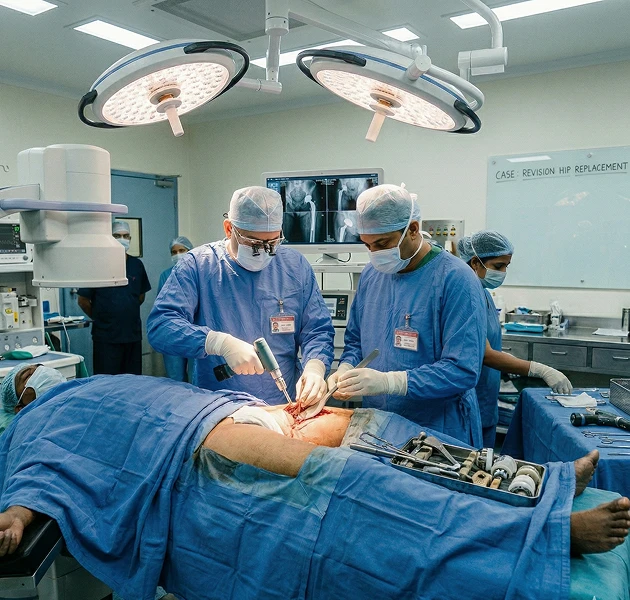
    Revision HIP Replacement at Trayam Hospital
    What is Revision Hip Replacement?

    Understanding Revision Hip Replacement Surgery

    Revision hip replacement is a surgical procedure to remove and replace a failed, worn, loose or infected hip implant. It is considerably more demanding than a primary (first-time) hip replacement — the surgeon must work through scar tissue from the original surgery, manage bone loss caused by the failing implant, and use specialised revision implant systems designed to achieve stable fixation when the normal bone stock has been compromised. The outcome of revision surgery is directly determined by the experience of the surgeon, especially a revision specialist, and the availability of the right implant systems on the day.

    The causes of hip replacement failure are varied — aseptic loosening (the implant working loose without infection) is the most common long-term cause, followed by periprosthetic joint infection (PJI), recurrent dislocation, bearing surface wear, and periprosthetic fracture. Each failure mode requires a fundamentally different surgical approach. Pre-operative assessment — CT scan for bone loss, infection markers (ESR, CRP, D-dimer), joint aspiration — is as important as the surgery itself. At Trayam Hospital, every revision hip case is assessed by our specialist team, including a revision hip replacement surgeon in Ahmedabad, with a full investigation protocol before any surgical decision is made.

    • Removes and replaces failed, loose, infected or worn hip implants — eliminates pain and restores function
    • Specialised revision implant systems — stems, cups, augments and constrained liners to handle bone loss and instability
    • Full pre-operative investigation — CT for bone loss mapping, infection markers, joint aspiration — before planning surgery
    • Two-stage revision protocol for infected implants — highest infection eradication rate (over 85%)
    • Bone loss reconstruction — impaction grafting, structural allograft and metal augments where required
    Do You Need It?

    Signs Your Hip Replacement May Have Failed

    If you have had a previous hip replacement and are experiencing these symptoms, a specialist review for hip revision surgery is recommended.

    Pain That Never Fully Resolved

    Pain That Never Fully Resolved

    Pain that persisted after hip replacement, or pain that was well-controlled for months or years and has returned. Pain in a replaced hip beyond 6 months post-surgery — or any new pain in a previously comfortable replaced hip — warrants specialist investigation, not repeated injections.
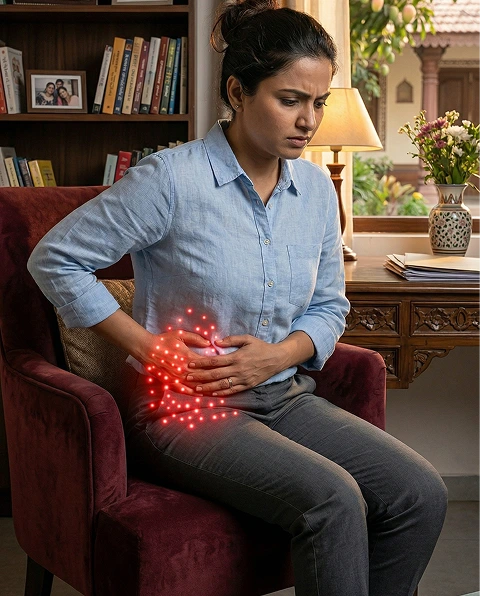
    Hip Feels Loose or Unstable

    Hip Feels Loose or Unstable

    A sense that the hip joint is not solid — subtle instability, apprehension with certain movements, or a feeling that the joint could give way. Component loosening, acetabular cup migration or ligament imbalance can all produce this symptom and require imaging assessment.
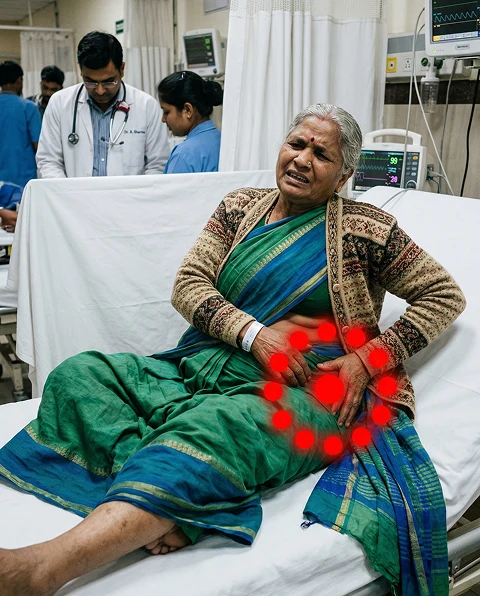
    Recurrent Hip Dislocation

    Recurrent Hip Dislocation

    The hip dislocating — the ball coming out of the socket — one or more times after the initial post-operative period. A hip that dislocates once has a high risk of recurrence. Recurrent dislocation requires urgent assessment — causes include cup malpositioning, soft tissue laxity and implant wear — all potentially correctable with revision surgery.

    Swelling, Warmth or Fever

    Swelling, Warmth or Fever

    Redness, warmth and swelling around the hip replacement — particularly with fever or feeling systemically unwell — strongly suggests periprosthetic joint infection. This is a surgical emergency if accompanied by systemic illness. Early diagnosis and treatment dramatically improves the chance of implant salvage or successful two-stage revision.

    Implant Shifted on X-Ray

    Implant Shifted on X-Ray

    Follow-up X-ray showing the acetabular cup has migrated, the femoral stem has subsided or a radiolucent (dark) line has appeared around the cement or implant interface — all signs of loosening. Even in the absence of severe pain, progressive loosening means accelerating bone loss — revision becomes more complex the longer it is deferred.
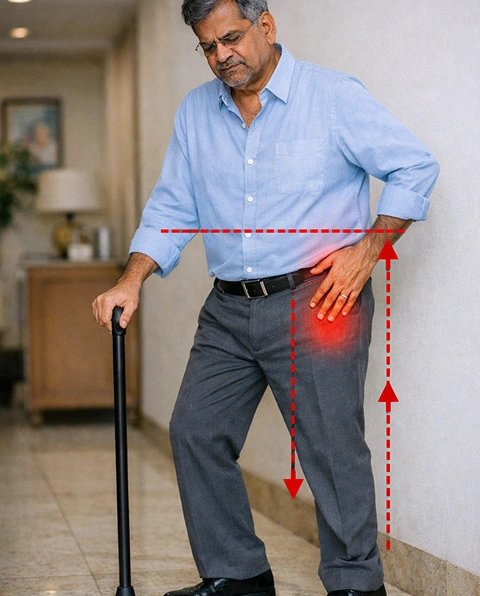
    Leg Length Discrepancy

    Leg Length Discrepancy

    A noticeable difference in leg length after hip replacement — one leg feels longer or shorter than the other. Leg length inequality over 5mm is associated with gait abnormality, lower back pain and hip abductor muscle weakness. If significant and not improving with physiotherapy, revision to correct implant positioning may be indicated.
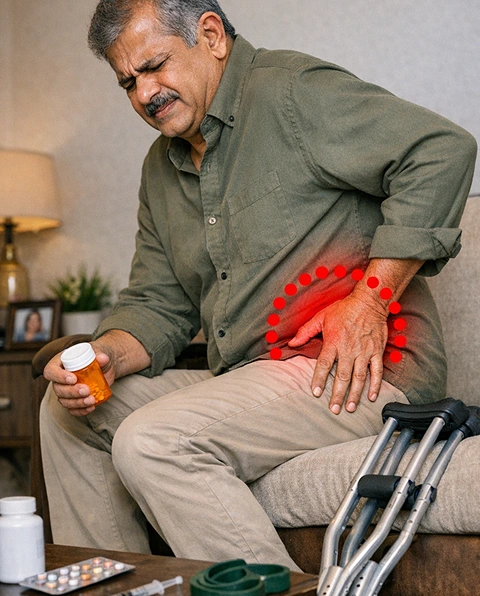
    Old Implant — 10+ Years Post-Surgery

    Old Implant — 10+ Years Post-Surgery

    Progressive pain, stiffness or functional decline in a hip replacement that is 10 years or older. Bearing surface wear produces debris that stimulates bone loss (osteolysis) around the implant — a process that is often radiologically advanced before symptoms develop. Annual X-ray review is important for early detection.
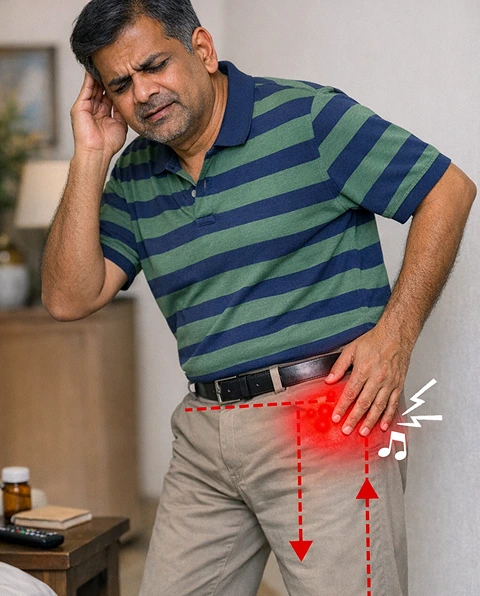
    Squeaking or Clicking Sounds

    Squeaking or Clicking Sounds

    Audible squeaking from a ceramic-on-ceramic hip replacement — or clicking sounds from any hip implant — may indicate bearing surface impingement, edge loading or early loosening. Noise from a hip replacement that is new or worsening warrants imaging assessment — do not normalise a hip that sounds wrong.

    Why Trayam

    Leading Choice for Revision Hip Surgery in Ahmedabad

    Revision hip replacement demands a different level of expertise, planning and implant availability, and the choice of centre matters.

    400+
    Revision Procedures
    100%
    Patient Satisfaction
    10+
    Years Experience
    FULL
    Revision Implant Range

    Full Pre-Revision Workup — No Guessing

    Every revision patient at Trayam undergoes a complete investigation protocol before the first surgical decision is made: standing X-rays, CT scan for three-dimensional bone loss mapping, ESR/CRP/interleukin-6 infection screening and joint aspiration where infection is suspected. The correct diagnosis of the failure mode determines the correct revision strategy — and the two are not always the same.

    Complete Revision Implant Inventory

    Revision hip replacement requires extended stems, jumbo cups, acetabular augments, constrained liners and trabecular metal components — none of which are part of a standard primary replacement theatre. Trayam carries a comprehensive revision hip implant inventory so the surgeon can manage any degree of bone loss or instability encountered intraoperatively, without compromise.

    Two-Stage Protocol for Infected Implants

    Periprosthetic joint infection requires a two-stage approach for the best outcomes: stage 1 removes the implant, debrides all infected tissue and places an antibiotic cement spacer; stage 2 re-implants a new prosthesis after 6–8 weeks of targeted antibiotics and confirmed infection clearance. This protocol achieves infection eradication in over 85% of cases — superior to single-stage revision for established infection.

    Bone Loss Reconstruction — Grafting and Augments

    Progressive loosening destroys bone around the implant — sometimes severely. Our surgeons are trained in impaction bone grafting, structural allograft reconstruction and the use of trabecular metal augments to rebuild the acetabulum and femur to a stable platform for revision fixation. Managing bone loss requires both surgical skill and access to the right materials — we have both.

    Revision Specialist — Volume and Experience

    Revision hip replacement is a subspecialty in its own right. Complication rates, operative time and implant choice decisions made intraoperatively all improve with surgical volume and specific fellowship training in revision arthroplasty. Our revision surgeons have the case volume, training and outcomes data to back their expertise.

    Second Opinions — Always Welcome

    If you have been told your hip replacement has failed and revision is needed — or if you are uncertain about advice you have received — we welcome second opinion consultations. We will independently review your imaging and investigations and give you an honest assessment of whether revision is indicated, what it involves and what outcome you can expect.

    Expert Care

    Meet Your Revision HIP Specialist

    Dr. Parth Patel — Trayam Hospital
    MS Orthopaedics Fellowship – Joint Replacement 10+ Yrs Exp.

    Dr. Parth Patel

    Senior Consultant — Joint Replacement & Revision Orthopaedic Surgery, Trayam Hospital

    Dr. Parth Patel has performed over 400 revision HIP replacement procedures — from straightforward single-component revisions to complex two-stage infected implant revisions with severe acetabular bone loss reconstruction. Revision HIP surgery demands a surgeon who has seen the full spectrum of failure modes, who approaches each case with a detailed pre-operative plan and who has the implant systems available to handle what is found once the joint is open. Every revision HIP patient at Trayam receives a personal consultation with full review of imaging and investigation results before any surgical decision is made.

    • MS Orthopaedics — B.J. Medical College Ahmedabad
    • Spine Fellowship (Indian Spinal Injury Centre, Delhi), Endoscopic Spine Fellowship (Asian Spine Hospital, Hyderabad), and Joint Replacement Fellowship under Dr. H. P. Bhalodiya at Saviour Hospital.
    • Mission: Clear diagnosis, clean surgery, and steady recovery for every patient.
    Procedures We Offer

    Types of Revision HIP Surgery

    The revision approach is determined by the cause and extent of failure — each scenario requires a distinct surgical strategy

    Aseptic Revision — Loosening & Wear

    The implant has loosened or the bearing surface worn without infection — the most common late failure mode. Revision involves removal of the loose components, bone loss assessment and management with augments or grafts, and implantation of revision-specific stems and cups designed for compromised bone. Single-stage procedure. Success rate over 90% at 10 years in correctly selected cases.

    Most Common

    Septic Revision — Infected Implant

    Periprosthetic joint infection (PJI) requires a staged approach. Stage 1: implant removal, radical debridement of all infected tissue, antibiotic cement spacer. 6–8 weeks of targeted IV then oral antibiotics. Stage 2: re-implantation when blood markers confirm infection clearance. Two-stage revision achieves infection eradication in over 85% of cases — the gold standard for established HIP PJI.

    Two-Stage

    Revision for Recurrent Dislocation

    A HIP replacement that dislocates repeatedly despite conservative management (bracing, activity modification). Assessment identifies the cause: cup malposition, inadequate offset, soft tissue laxity or implant impingement. Revision surgery corrects the anatomical problem — repositioning the cup, increasing the femoral head size, using a constrained liner or restoring offset. Recurrent dislocation after HIP replacement is correctable — it should not be accepted as permanent.

    Instability

    Complex Revision — Bone Loss & Periprosthetic Fracture

    Severe bone loss from long-standing loosening or osteolysis, and periprosthetic fractures around a HIP implant — the most demanding revision scenarios. Require trabecular metal augments, impaction bone grafting or structural allograft, and extended proximal femoral replacement in extreme cases. These cases require a centre with the full implant inventory, bone graft availability and surgeon experience to manage the full spectrum of intraoperative findings.

    Complex
    What to Expect

    Your Recovery Journey After Revision HIP Replacement

    A step-by-step guide to your recovery after Revision HIP Replacement at Trayam Hospital.

    Day 1–2

    Surgery completed. Physiotherapy begins — first assisted standing and walking with a frame. Close monitoring of wound, blood count and inflammatory markers. Pain managed with multimodal analgesia protocol.

    Day 4–7

    Hospital discharge for straightforward aseptic revisions. Two-stage septic revision patients remain for IV antibiotic management before oral transition. Walking with frame. Wound review at day 5–7.

    Week 2–3

    Wound review and suture removal. Home physiotherapy programme established. Swelling and bruising reducing. HIP precaution restrictions in place — reviewed at 6-week appointment.

    Week 6–8

    Outpatient review with X-ray confirming implant position and early bone ingrowth. Most patients walking with a stick or unaided. HIP precautions lifted. Driving discussed.

    Month 3

    Significant improvement in pain and function compared to pre-revision. Most daily activities resumed. Physiotherapy continuing with strength and balance emphasis.

    Month 6–12

    Full functional recovery for most patients. Return to recreational activity. Annual follow-up X-ray lifelong — essential for revision patients to monitor implant stability and detect early bone changes.

    Patient Stories

    What Our Patients Say

    "My HIP replacement from 2014 started hurting again in 2022. Three consultations elsewhere — X-ray looks fine, have an injection. At Trayam, Dr. Parth ordered a CT and aspiration. The cup had migrated and there was significant osteolysis around the acetabulum. Revision surgery rebuilt the socket with an augment. I am now one year post-revision with zero pain. The CT scan made the diagnosis — plain X-ray was insufficient."

    Nareshbhai M.
    Aseptic Cup Revision — Osteolysis & Migration • Age 71 • Ahmedabad

    "My HIP replacement became infected 8 months after primary surgery. It was a terrifying experience — pain, fever and swelling. The two-stage revision at Trayam was managed brilliantly. Stage one removed the implant, six weeks of antibiotics confirmed infection was cleared, and then the new HIP was placed. That was 18 months ago. I now have a pain-free, stable HIP and no sign of infection. The team's expertise in this area is exceptional."

    Lalitaben K.
    Two-Stage Septic Revision — PJI • Age 65 • Surat

    "My HIP kept dislocating — three times in eight months after my original replacement. I was terrified to move. Dr. Parth identified that the cup had been placed in a non-optimal position causing impingement and instability. A cup revision corrected the angle and a larger head was used. It has now been 14 months without a single dislocation. I wish I had come here after the first dislocation."

    Girishbhai P.
    Cup Revision for Recurrent Dislocation • Age 59 • Vadodara
    A Common Problem in India

    Painful HIP Replacement — Still Being Managed with Injections and Reassurance?

    The most persistently under-investigated problem in HIP replacement in India is the patient with a failing implant who is repeatedly reassured that their X-ray looks normal. Plain X-rays miss acetabular cup migration, early osteolysis and subtle loosening that is clearly visible on CT. A patient whose replaced HIP is painful, unstable or showing progressive functional decline deserves a systematic investigation — not another steroid injection and a 3-month review appointment.

    • Pain after HIP replacement managed with injections without investigating the cause — injections into a replaced HIP joint may temporarily reduce inflammation but do not address loosening, infection or component malposition. Any HIP replacement pain beyond 6 months post-surgery, or new pain in a previously comfortable HIP, requires CT imaging, infection markers and — where infection is suspected — joint aspiration. These investigations, not injections, provide the diagnosis.
    • Told revision HIP surgery is "too risky" or "not possible" — revision HIP replacement is technically demanding and carries higher complication risk than primary replacement, but it is almost always possible. A statement that revision cannot be performed typically reflects the treating surgeon's experience or implant inventory limitations. Every patient with a symptomatic failed HIP replacement deserves assessment by a surgeon who performs revision surgery regularly.
    • Recurrent HIP dislocation managed with bracing and activity restriction indefinitely — a HIP replacement that dislocates repeatedly is not functioning adequately and the underlying cause needs to be identified and corrected. Cup malpositioning, inadequate femoral offset and soft tissue deficiency are all correctable with revision surgery. Indefinite bracing is not an acceptable long-term solution for recurrent dislocation.
    • No annual X-ray follow-up for an implant over 10 years old — bearing surface wear and early osteolysis are often radiologically advanced before symptoms develop. An annual follow-up X-ray for any HIP replacement over 10 years old allows early detection of these changes and timely revision before bone loss becomes severe. Patients who have not had a follow-up X-ray in several years should request one proactively.
    The Trayam Promise What we quote is what you pay. No surprises. No fine print. No pressure.

    Full Cost Breakdown — Specified in Detail

    Revision surgery pricing varies significantly with complexity and implant requirements. We provide a fully itemised estimate — surgery, implant systems named and specified, stay and rehabilitation — before you commit. No flat revision package that may not cover what is found intraoperatively.

    Honest Assessment — Revision Only When Indicated

    We will tell you if your HIP replacement pain can be managed without surgery. We do not recommend revision unless investigation confirms a clear, treatable cause of failure. An honest second opinion — even if the answer is that revision is not yet needed — is always available.

    Insurance for Complex Revision Cases

    Revision HIP replacement is covered under most major health insurance policies. The complexity and specific implant requirements are documented correctly in the pre-authorisation submission. Our insurance desk manages this process in full — no inflated billing, no misrepresentation.

    Painful HIP replacement? Dislocating? Old implant? You deserve a proper investigation by a revision specialist, not another injection.

    Confidential  ·  No Obligation  ·  Reply in 2 Hours

    Common Questions

    Frequently Asked Questions

    Revision HIP replacement removes and replaces a failed, worn, loose or infected HIP implant. It is more complex than primary HIP replacement, requiring specialised implant systems, specific surgical training and thorough pre-operative investigation to determine the cause of failure.

    Signs include: pain that never resolved or has returned after a period being well, recurrent dislocation, warmth and swelling suggesting infection, X-ray showing a shifted implant, noticeable leg length difference, or progressive functional decline. Any of these warrants specialist review.

    Typically 2–3 hours for straightforward single-component revisions; 3–4+ hours for complex revisions with significant bone loss reconstruction — longer than primary HIP replacement due to scar tissue, bone loss management and larger revision implant systems.

    Stage 1: implant removal, debridement of all infected tissue, antibiotic cement spacer. 6–8 weeks of targeted antibiotics. Stage 2: re-implantation once blood markers confirm infection clearance. Two-stage revision achieves over 85% infection eradication — the gold standard for established HIP PJI.

    Straightforward aseptic revision: 5–7 days. Two-stage septic revision: stage 1 approximately 7–10 days; stage 2 approximately 5–7 days. Complex reconstructions may require longer depending on bone grafting requirements.

    Yes — recurrent dislocation after HIP replacement has identifiable causes that are surgically correctable. Cup repositioning, use of a larger femoral head, constrained liner or soft tissue reconstruction addresses the specific cause. Revision for recurrent dislocation has high success rates when the correct diagnosis is made pre-operatively.

    Longer than primary replacement — most patients reach functional recovery by 3–6 months. Complex reconstructions with significant bone grafting may take 9–12 months. Annual lifelong X-ray follow-up is essential for all revision patients.

    Yes — covered by most major Indian health insurance policies and PMJAY. We manage pre-authorisation ensuring that the complexity and implant requirements are correctly documented and claimed in full.

    Failed HIP Replacement? You Deserve a Specialist Assessment — Not Another Injection

    Bring your X-rays, any existing reports and your surgical history. Our revision specialist will give you an independent, honest assessment of your options — and tell you clearly whether revision is needed and what it involves.

    Chat on WhatsApp