Revision Trauma & Fracture Centre

Revision Fracture Surgery — When the First Fracture Treatment Did Not Work

A fracture that has not healed, has healed in the wrong position, or has broken its implant is not a final diagnosis — it is a problem with a solution managed by a fracture revision surgeon in Ahmedabad. Revision fracture surgery corrects malunion, achieves union in nonunion, and addresses implant failure with the right technique the second time.

90%+
Union After Revision
Second
Opinion Welcome
Full
Implant Inventory
10+
Years Revision Exp.
Insurance & PMJAY Accepted
Revision Trauma Specialists
Second Opinions Welcome

Book A Consultation

Our specialist will call you within 2 hours
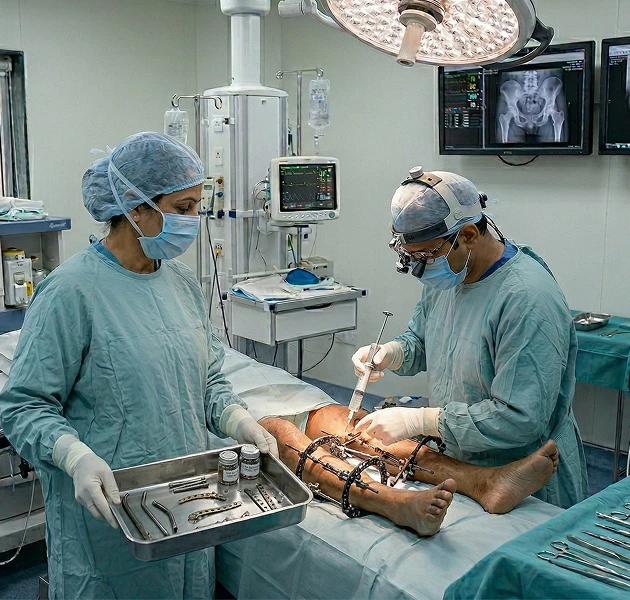
    Revision Fracture Surgery at Trayam Hospital
    What is Revision Fracture Surgery?

    Understanding Revision Fracture Surgery

    Revision fracture surgery is the surgical correction of a fracture that has failed to heal correctly after initial treatment — either because it has not healed at all (nonunion), has healed in an incorrect position (malunion), or because the implant used to fix it has failed (broken plate, bent nail, loose screws), requiring revision fracture surgery in Ahmedabad. These are not rare outcomes — nonunion occurs in approximately 5–10% of fractures, and malunion is even more common when fractures are inadequately reduced or insufficiently stabilised at the index procedure.

    The approach to revision fracture surgery is systematic: first, identify why the primary treatment failed — inadequate fixation, poor biology (infection, poor blood supply, metabolic deficiency), incorrect implant choice or patient factors, evaluated by a fracture revision surgeon in Ahmedabad. Then address the cause as part of the revision — not just change the implant. A nonunion revised with the same technique that failed the first time will fail again. At Trayam Hospital, every revision fracture case undergoes a thorough assessment — X-rays, CT scan for fracture gap and callus assessment, infection markers, metabolic screen — before the revision surgical plan is made by a fracture revision surgeon.

    • Nonunion treatment — exchange nailing, bone grafting, compression plating or combination — matched to failure cause
    • Malunion correction — osteotomy (controlled re-fracture), realignment and fixation — restoring anatomy and function
    • Implant failure removal and revision — broken plates, bent nails and loose screws removed and replaced with appropriate fixation
    • Infection assessment before every revision — infected nonunion requires a fundamentally different approach
    • Metabolic screen — Vitamin D, calcium, bone turnover markers — addressing systemic factors that impair healing
    When Is Revision Needed?

    Signs Your Fracture Has Not Healed Correctly

    These symptoms — weeks to months after a fracture — indicate that the original treatment has not achieved the expected outcome and specialist review is needed
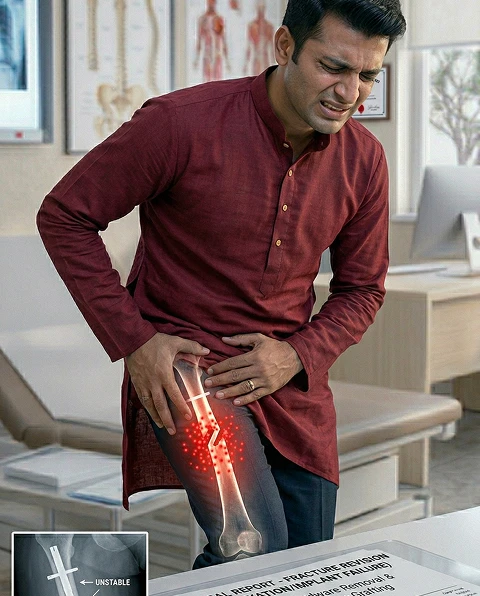
    Fracture Not Healed — Pain Persisting Beyond 6 Months

    Fracture Not Healed — Pain Persisting Beyond 6 Months

    Significant pain at the fracture site beyond 6 months after injury — with X-ray showing no bridging callus, persistent fracture gap or sclerotic fracture ends. Nonunion is defined as failure to heal by 6 months with no radiological evidence of progression toward union. Beyond this point, the fracture will not heal without surgical intervention to stimulate bone healing.
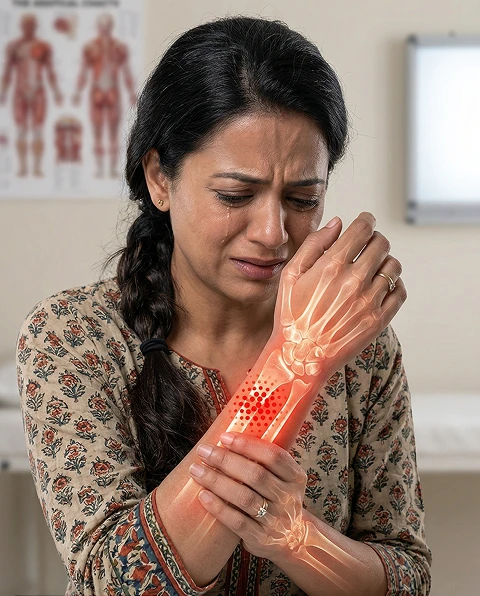
    Visible Deformity — Bone Healed Crooked

    Visible Deformity — Bone Healed Crooked

    A limb that has healed with visible angulation, rotation or shortening — arm, leg, forearm or clavicle in a position that is cosmetically or functionally abnormal. Malunion causes asymmetric joint loading, abnormal gait, compensatory joint strain and, if uncorrected, progressive arthritis in adjacent joints.
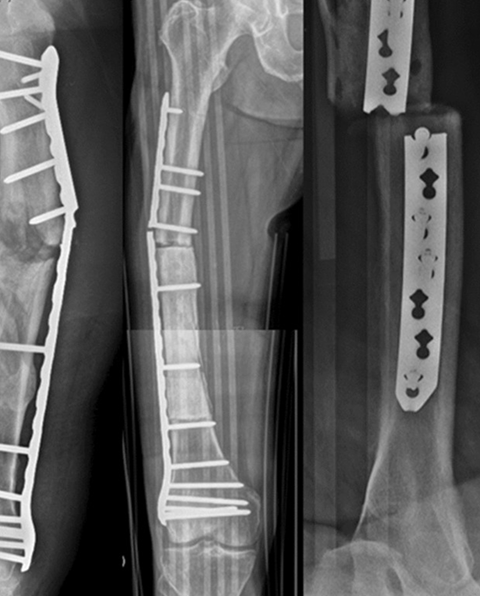
    Broken Plate or Bent Nail

    Broken Plate or Bent Nail

    An X-ray showing a fractured plate, broken screw, bent intramedullary nail or failed fixation — the implant has fatigued before the bone healed. Implant failure confirms that the fracture has not united and the mechanical environment was inadequate. Broken hardware must be removed and the fracture re-fixed with appropriate revision fixation and — in most cases — bone grafting.
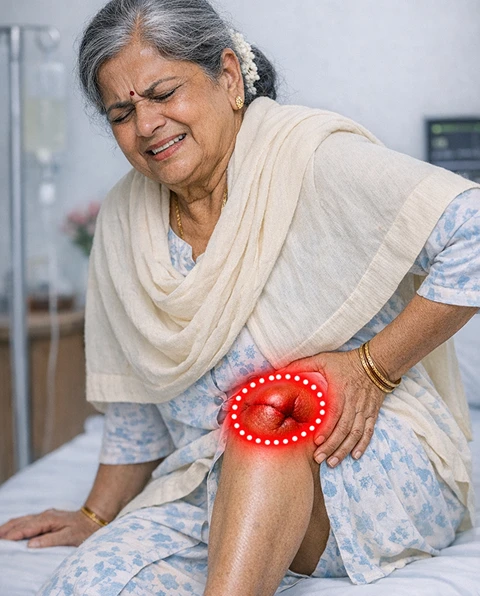
    Wound Discharge or Sinus at Old Fracture Site

    Wound Discharge or Sinus at Old Fracture Site

    A discharging wound, sinus tract or recurring infection at or near a healed or non-healed fracture with implants in situ — strongly suggests implant-related infection (chronic osteomyelitis). Infected nonunion is the most complex revision scenario — requiring implant removal, infection debridement, antibiotic treatment and staged reconstruction before definitive re-fixation.
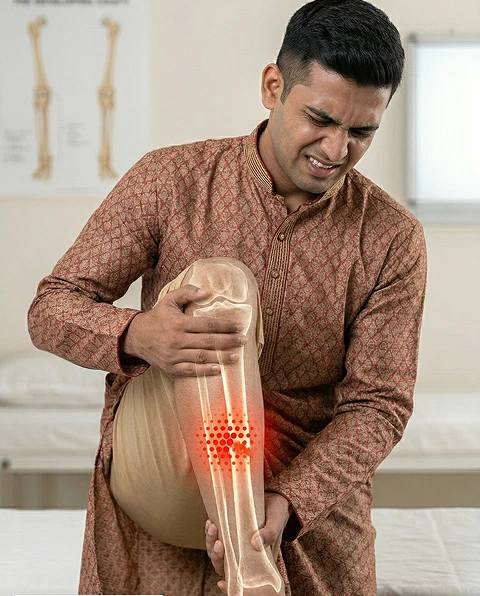
    Movement at the Fracture Site — Mechanical Instability

    Movement at the Fracture Site — Mechanical Instability

    Palpable or audible movement at the fracture site when loading the limb — confirming mechanical nonunion. The fracture ends are moving against each other rather than consolidating. This continued micromotion prevents callus maturation and perpetuates the nonunion cycle until surgical stability is restored.
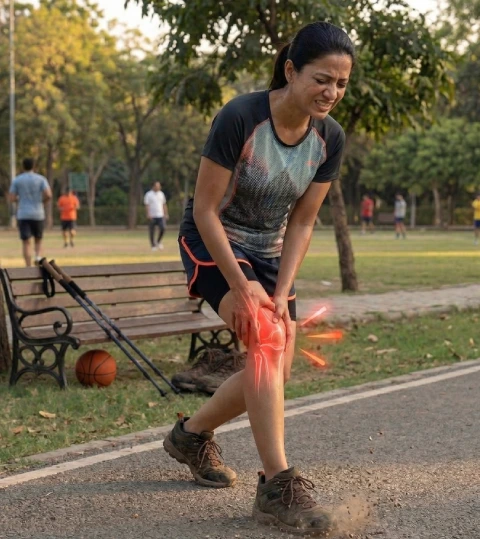
    Active Lifestyle Affected

    Limp or Abnormal Gait After Lower Limb Fracture

    A persistent limp, inability to run, or abnormal gait pattern after a lower limb fracture that appeared to heal — suggesting malunion with rotational or angular malalignment that has altered lower limb biomechanics. Clinical and radiological assessment of alignment — including full-length standing films — quantifies the deformity and guides correction planning.
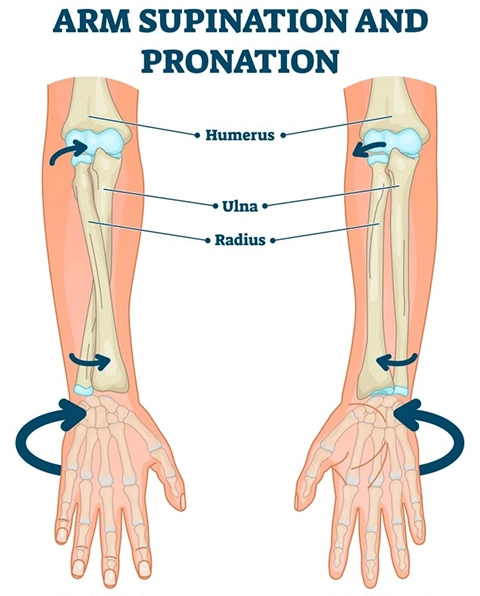
    Loss of Forearm Rotation After Radius / Ulna Fracture

    Loss of Forearm Rotation After Radius / Ulna Fracture

    Inability to fully supinate or pronate the forearm after a radius or ulna fracture — indicating malunion with rotational malalignment of the forearm bones. Even small degrees of forearm bone malrotation significantly impair forearm rotation and hand function. Corrective osteotomy restores rotation that physio alone cannot achieve.
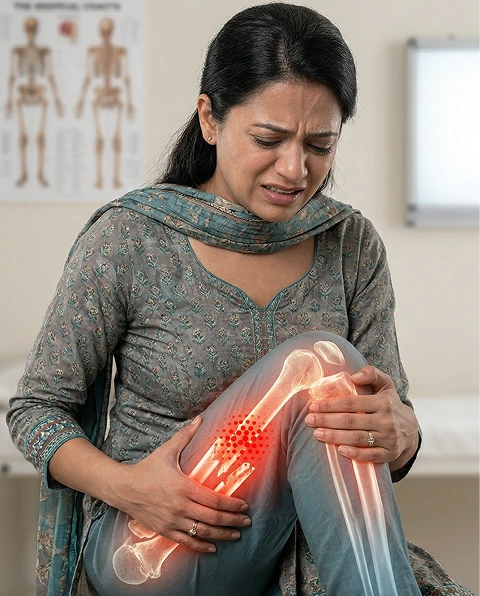
    Chronic Pain at an Old Fracture Site

    Chronic Pain at an Old Fracture Site

    Persistent, localised pain at the site of a fracture that was treated months or years ago — in a patient who was told "the bone has healed." Not all radiologically healed fractures are symptom-free — prominent implants, malunion causing abnormal load and low-grade infection all cause chronic post-fracture pain that can be investigated and treated.

    Why Trayam

    Leading Revision Fracture Surgery in Ahmedabad

    Revision fracture surgery is more demanding than primary fixation — the cause of failure must be identified and corrected, not just the implant changed by a fracture revision surgeon in Ahmedabad

    90%+
    Union After Revision
    Full
    Implant Inventory
    Infection
    Excluded Before Revision
    Second
    Opinion Welcome

    Systematic Failure Analysis — Why Did It Fail?

    The most common error in revision fracture surgery is repeating the technique that failed. Before any revision, we determine why the fracture failed to heal: inadequate fixation stability, poor blood supply to the fracture, infection, metabolic deficiency (Vitamin D, calcium, hypothyroidism), or patient factors (smoking, diabetes, poor nutrition). The revision plan addresses the cause — not just the implant.

    Infection Excluded Before Every Revision

    Infected nonunion requires a completely different approach from aseptic nonunion — if infection is missed and revision fixation is placed into an infected fracture, the revision will fail and the infection will worsen. Every revision fracture patient has ESR, CRP, white cell count and, where indicated, fracture site aspiration or biopsy before revision surgery. Infected cases are managed with staged debridement and antibiotic treatment before re-fixation.

    Bone Grafting — Biological Stimulation for Nonunion

    Most nonunions have failed because the biological environment at the fracture site is insufficient for healing — poor blood supply, sclerotic bone ends, inadequate callus. Revision surgery includes iliac crest bone graft or reamer-irrigator-aspirator (RIA) bone graft harvesting — providing the osteogenic, osteoconductive and osteoinductive factors that stimulate new bone formation at the nonunion site.

    Osteotomy Planning for Malunion — CT and Template

    Corrective osteotomy for malunion requires precise pre-operative planning — the exact cuts, correction angles and fixation sequence planned on CT scan or digital templates before surgery. Under-correction leaves residual deformity; over-correction creates a new problem. Our osteotomy planning is CT-based and templated — not estimated intraoperatively.

    Full Revision Implant Inventory

    Revision fracture surgery often requires larger implants, longer nails, locking systems and bone graft substitutes not needed for primary fixation. We carry a comprehensive revision trauma implant inventory — including exchange nails in multiple diameters, locking plates for all anatomical regions, and external fixators for staged reconstruction — so the revision plan is never compromised by what is in stock.

    Second Opinion — Always Welcome

    If you have been told your fracture cannot be healed, your nonunion is "untreatable" or your malunion "does not need correction" — and you are still in pain or have functional limitation — our revision team welcomes second opinion consultations. Bring your X-rays, CT scans and operative notes. We will give you an independent honest assessment of what can be achieved.

    Expert Care

    Meet Your Revision Fracture Specialist

    Dr. Parth Patel — Trayam Hospital
    MS Orthopaedics Fellowship – Joint Replacement 10+ Yrs Exp.

    Dr. Parth Patel

    Senior Consultant — Revision Trauma & Reconstructive Fracture Surgery, Trayam Hospital

    Dr. Parth Patel has specific expertise in the management of nonunion, malunion and failed fracture fixation — conditions that require a different and more analytical approach than primary fracture surgery. With AO Foundation advanced training in fracture reconstruction and over 10 years of revision trauma experience, Dr. Parth Patel approaches every revision case with a systematic failure analysis before planning surgery. A fracture that has failed once needs to be understood — not just reoperated.

    • MS Orthopaedics
    • Fellowship in Joint Replacement
    • International Training
    • Published in 10+ peer-reviewed journals
    • Speaker at National & International Orthopaedic Conferences
    Procedures We Offer

    Revision Fracture Procedures

    Each revision scenario requires a specific approach — here is how we treat the most common patterns of failed fracture healing

    Nonunion Treatment — Exchange Nailing & Bone Grafting

    Aseptic nonunion (no infection): exchange nailing — removing the existing nail and replacing with a larger diameter nail that provides greater stability and generates an osteogenic reaming slurry that stimulates healing — is the first-choice revision for long bone nonunions. Success rate over 90% for femoral and tibial shaft nonunions. Adjunctive iliac crest or RIA bone graft added for atrophic nonunions with poor biological environment. Hypertrophic nonunions (abundant callus, adequate biology, insufficient stability): compression plating without graft.

    Nonunion

    Malunion Correction — Corrective Osteotomy

    Malunion with significant angular, rotational or length deformity — causing functional impairment, gait abnormality or joint strain. Treatment: corrective osteotomy — the malunited bone is carefully re-cut at the deformity apex, realigned to the planned correction angles and fixed with a plate, nail or external fixator. Planning is CT-based. Acute correction for most cases; gradual correction with a circular (Ilizarov) frame for complex or multi-plane deformities or when bone lengthening is simultaneously required.

    Malunion

    Broken Implant Removal & Re-fixation

    Broken plate, fractured nail or failed screws — removed with specialised extraction equipment (broken screw extractors, trephines, reverse-cutting taps). Re-fixation with appropriate revision implant — exchange nail, longer locking plate or combined plate-and-nail construct. Bone graft added to address the biological deficiency that caused the implant to fatigue before the bone healed. CT scan pre-operatively to assess fracture gap, callus pattern and bone quality at revision.

    Implant Failure

    Infected Nonunion — Staged Reconstruction

    The most complex revision scenario: infection confirmed by microbiology plus mechanical nonunion. Stage 1: implant removal, aggressive debridement of all infected and devitalised bone and soft tissue, temporary stabilisation with antibiotic-loaded cement beads or spacer and external fixator. 6–8 weeks of targeted antibiotics. Stage 2: re-fixation with definitive implant plus bone grafting once infection is cleared and CRP/ESR normalised. Bone transport (Ilizarov) for large bone defects after debridement. Success rates 75–85% — demanding for both surgeon and patient, but achievable.

    Implant Failure
    What to Expect

    Recovery After Revision Fracture Surgery

    Day 1–3

    Surgery completed. Pain managed. Weight-bearing status per fixation and fracture location — explained before discharge. Physiotherapy begins: adjacent joint movement, elevation and swelling control.

    Week 2

    Wound review and suture removal. X-ray confirming implant position and alignment. Physiotherapy progressing. For infected nonunion patients on IV antibiotics — transition to oral antibiotics reviewed with microbiology.

    Week 4–6

    Follow-up X-ray — early callus formation assessed. Gradual weight-bearing progression for lower limb cases. Upper limb: progressive active movement and strengthening. Bone graft sites (iliac crest) healing — donor site discomfort resolving.

    Week 10–12

    X-ray confirming bridging callus — bone healing progressing. Full weight-bearing initiated for most lower limb nonunions with confirmed callus. Malunion osteotomy patients: union confirmed, physiotherapy progressing to functional strengthening.

    Month 4–6

    Most revision nonunions and malunion osteotomies united and fully weight-bearing. Return to work and daily activities. Implant removal discussed where applicable — retained implants reviewed at this stage.

    Month 6–12

    Full recovery for most patients. Return to pre-injury activity level — sport, physical work, full daily function. Infected nonunion patients: final infection clearance confirmed with blood markers and clinical assessment. Annual follow-up not required for uncomplicated united revision cases.

    What Our Patients Say

    "My tibial fracture had been operated twice at two different hospitals in 18 months — still not healed, the second nail had bent. I had been told the bone might not heal. At Trayam, Dr. Parth Patel identified that my Vitamin D was critically low and my original nail was too small for my bone size. Exchange nailing with a larger nail plus bone graft and Vitamin D correction — my tibia healed at 14 weeks. Three surgeries and the third time was finally right because someone looked for why it had failed twice."

    Arjunbhai K.
    Tibial Shaft Nonunion — Exchange Nail + Bone Graft • Age 31 • Ahmedabad

    "My forearm fracture healed crooked — I could not pronate my forearm fully, which means I cannot turn a screwdriver, pour a glass or type normally. Two years of physiotherapy made no difference. Corrective osteotomy at Trayam restored my forearm rotation to near normal. The planning Dr. Parth Patel showed me before surgery — exactly where the cut would be made and how much correction was planned — gave me complete confidence. The result at 6 months has exceeded my expectations."

    Dilipbhai V.
    Radius Malunion Corrective Osteotomy • Age 43 • Surat

    "My femur had a discharging sinus for 2 years after the original plating — infected nonunion. I had been to three hospitals with no clear plan beyond antibiotics. At Trayam, Dr. Parth Patel staged the treatment properly: implant removal and debridement, 8 weeks of targeted antibiotics, then re-fixation with a nail and bone graft. The bone healed, the infection cleared and the sinus has been dry for 18 months. This is what a proper treatment plan looks like."

    Narendrabhai S.
    Infected Femoral Nonunion — Staged Reconstruction • Age 47 • Vadodara
    A Common Problem in India

    Fracture Reoperated Twice — Same Technique Both Times, Still Not Healed?

    The most common and most avoidable reason revision fracture surgery fails is repeating the technique that failed the first time without identifying why it failed. A nonunion revised with the same nail diameter, without bone graft, and without checking infection markers or Vitamin D, will fail again — for the same reasons. Revision fracture surgery requires a systematic approach to failure analysis that goes beyond changing the implant. It also requires honest acknowledgement that the first operation did not succeed — and a clear explanation to the patient of what was done, what failed and what the revised plan addresses differently.

    • Fracture nonunion re-operated with the same implant and technique without investigating why it failed — if your fracture has been operated twice and has not healed, the question is not "which implant to try next" — it is "why has this fracture not healed?" The failure analysis must assess: Was the fixation stable enough? Was there infection? Are there metabolic deficiencies (Vitamin D, calcium, thyroid)? Is the blood supply adequate? A revision that does not address these questions is likely to fail for the same reason.
    • Nonunion managed indefinitely with bracing, physiotherapy and supplements without surgical assessment — a nonunion beyond 6 months with no radiological evidence of progression will not heal with conservative management. Supplements and physiotherapy can optimise the biological environment, but cannot provide the mechanical stability that a nonunion requires for healing. If your fracture has been "being monitored" for more than 6 months with no healing on X-ray — surgical assessment is overdue.
    • Malunion dismissed as "acceptable" without functional assessment — a malunited fracture that causes a limp, prevents forearm rotation, limits elbow or knee movement or causes abnormal joint loading is not "acceptable" — it is a correctable problem. Malunion correction should be discussed with any patient who has functional limitation from a healed fracture in poor position, before the compensatory joint changes become irreversible.
    • Infected nonunion treated with antibiotics and implant retention — antibiotics alone cannot eradicate infection around a metal implant — the implant harbours bacteria in a biofilm that antibiotics cannot penetrate. Infected nonunion requires implant removal, surgical debridement and staged reconstruction — not prolonged antibiotic courses with the original hardware still in place. If you have been on antibiotics for months for an infected fracture site with no improvement, the implant needs to come out.
    The Trayam Promise : We find out why it failed before we decide how to fix it. The revision plan addresses the cause — not just the implant.

    Failure Analysis First — Before Any Revision

    CT scan, infection markers, metabolic screen and mechanical assessment before every revision plan. We will tell you what caused the failure and what the revision addresses differently. No repeat of the same technique that failed without a clear reason why it will work differently.

    Infection Excluded Before Re-fixation

    Every revision fracture patient has ESR, CRP and where indicated fracture site aspiration before surgery. Infected nonunion is managed with staged debridement and antibiotics first — re-fixation only after confirmed infection clearance.

    Insurance for Revision Fracture Surgery

    Revision fracture surgery — including nonunion repair, malunion osteotomy and infected nonunion reconstruction — is covered by most major Indian health insurance policies and PMJAY. Our insurance desk manages pre-authorisation with correct documentation of the revision indication.

    Fracture not healing? Healed crooked? Broken implant? Get an honest assessment — not another operation without a plan.

    Confidential  ·  No Obligation  ·  Reply in 2 Hours

    Common Questions

    Frequently Asked Questions

    Nonunion is failure of a fracture to heal — defined as no radiological progression toward union at 6 months. Beyond this point, the fracture will not heal without surgical intervention. Surgery addresses both the mechanical environment (fixation stability) and the biological environment (bone graft, vascularity) that the original fixation failed to provide.

    Exchange nailing removes the existing nail and replaces it with a larger diameter nail that provides greater stability and generates an osteogenic reaming slurry (bone dust and marrow cells) as it is inserted — biologically stimulating healing. It is the first-choice revision for long bone shaft nonunions with a success rate over 90% for femoral and tibial nonunions.

    Malunion is a fracture that has healed in an incorrect position — causing angular deformity, rotation, shortening or a combination. Correction is recommended when the malunion causes functional limitation (gait abnormality, loss of rotation, limited joint movement), abnormal joint loading that will lead to arthritis, or significant cosmetic deformity.

    The malunited bone is carefully re-cut at the deformity apex — a controlled surgical fracture — realigned to the pre-planned correction angles and fixed with a plate, nail or external fixator. Planning is CT-based and performed digitally before surgery. Acute correction in most cases; gradual correction with an Ilizarov frame for complex multi-plane deformities.

    Infected nonunion combines bone infection with failure to heal — the most complex revision scenario. Treatment is staged: Stage 1 — implant removal, aggressive debridement, antibiotic cement beads, external fixator. 6–8 weeks of targeted antibiotics. Stage 2 — re-fixation with bone graft once infection is cleared. Success rate 75–85%. Antibiotics alone without implant removal do not work.

    Yes — with specialised extraction equipment: broken screw extractors, trephines and reverse-cutting taps for stripped screw heads. Broken nail removal uses manufacturer-specific extraction sets. Removal of fractured hardware requires surgical expertise and the correct instruments — it is not always straightforward. At Trayam, we carry the full range of implant extraction equipment.

    Similar to primary fracture healing — 10–16 weeks for most nonunions to unite after revision. Malunion osteotomy: 8–14 weeks to union. Infected nonunion reconstruction: 6–9 months total treatment duration including antibiotic phase and re-fixation. Regular X-ray follow-up confirms progress.

    Yes — nonunion repair, malunion correction and infected nonunion reconstruction are covered by most major Indian health insurance policies and PMJAY. Pre-authorisation requires documentation of the revision indication — our insurance desk manages this in full.

    Fracture Not Healing? Healed Wrong? Broken Implant? Get the Revision Right This Time

    Bring your X-rays, CT scans and operative notes. Our revision specialist will tell you exactly what failed, what the plan addresses and what outcome is realistic. Second opinions always welcome.
    Chat on WhatsApp