Large Kidney Stone Specialists — PCNL & Mini-PCNL

PCNL Surgery — 85–95% Stone-Free Rate for Large Kidney Stones in One Procedure

Percutaneous nephrolithotomy (PCNL) is the gold standard treatment for kidney stones over 2cm and staghorn calculi, with PCNL surgery in Ahmedabad offering high single-session stone clearance. A small puncture in the back — no large open incision — with stone-free rates of 85–95% in a single procedure, 2–3 day hospital stay and return to work within 10 days.

85–95%
Stone-Free Rate
2–3
Day Hospital Stay
Mini
PCNL Available
No
Open Surgery
Standard, Mini & Ultra-Mini PCNL
PMJAY / Insurance Accepted
Holmium Laser Fragmentation
Same-Day Consultation

Get Expert Advice Now

Tell us your symptoms — we’ll guide you immediately
Stone with fever? This is a urological emergency — do not wait for a routine appointment

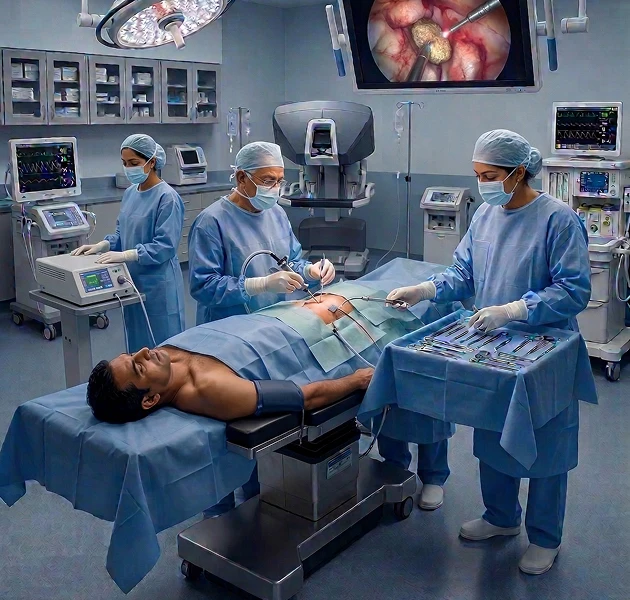
    PCNL Surgery at Trayam Hospital
    Understanding PCNL

    What Is PCNL and When Is It Needed?

    Percutaneous nephrolithotomy (PCNL) is a minimally invasive keyhole procedure for removing large kidney stones — those over 2cm, staghorn calculi filling the renal collecting system, and stones that have failed less invasive treatment, with PCNL surgery in Ahmedabad offering high single-session clearance rates. Under general anaesthesia, a small puncture is made in the flank under X-ray or ultrasound guidance, a nephroscope is passed directly into the kidney, and the stone is fragmented with a Holmium laser or pneumatic lithotripter and removed through the same tract. No large open incision — just a small puncture the size of a pencil.

    The key advantage of PCNL over ESWL or URS for large stones is the stone-free rate: 85–95% in a single session for stones over 2cm, compared to 40–60% for ESWL requiring multiple sessions, making PCNL kidney stone surgery in Ahmedabad the preferred option for large stone burden. Mini-PCNL (smaller tract) reduces blood loss and post-operative pain with equivalent stone-free rates. A complete CT KUB and sterile urine culture are mandatory before every PCNL — the right preparation prevents the most serious complications.

    • PCNL indicated for stones over 2cm, staghorn calculi, lower pole stones over 1.5cm and ESWL failures
    • Mini-PCNL (14–20 Fr tract) — less bleeding, faster recovery, equivalent stone-free rate for 1.5–3cm stones
    • Stone-free rate 85–95% in single session — far superior to ESWL for stones of this size
    • Sterile urine culture before every PCNL — mandatory, non-negotiable; infected urine + PCNL = potentially fatal urosepsis
    • Metabolic evaluation after PCNL — stone composition analysis and prevention plan to reduce recurrence from 50% to under 15%
    PCNL Indications

    Which Kidney Stones Need PCNL?

    Not every kidney stone needs PCNL. The decision depends on stone size, location, composition and whether previous treatment has failed. These are the situations where PCNL is the right choice.

    Over 2cm
    primary PCNL indication

    Large Kidney Stones (>2cm)

    Kidney stones over 2cm in the renal pelvis or calyces — PCNL is the gold standard. ESWL stone-free rate for stones this size is 40–60%, frequently requiring multiple sessions. PCNL achieves 85–95% stone-free rate in a single procedure. CT KUB maps the stone anatomy precisely to plan the optimal calyceal access point.

    PCNL Gold Standard
    Staghorn
    requires PCNL

    Staghorn / Coral Calculus

    A stone filling the renal pelvis and extending into multiple calyces. Usually struvite or calcium phosphate. Cannot be treated with ESWL or URS alone. Standard PCNL with multiple punctures or staged procedures achieves the highest stone-free rates. Untreated staghorn calculi cause irreversible kidney damage, recurrent infection and kidney failure.

    Cannot Delay Treatment
    1.5–3cm
    optimal range

    Mini-PCNL Candidates

    Stones 1.5–3cm in accessible calyceal positions — mini-PCNL (14–20 Fr tract) achieves equivalent stone-free rates to standard PCNL with smaller tract, less blood loss, less post-operative pain and faster recovery. CT anatomy determines whether mini or standard is optimal for each individual stone.

    Smaller Tract, Same Result
    After
    ESWL failure

    ESWL Failures & Lower Pole Stones

    Stones that have not fragmented after one or two ESWL sessions, and lower pole stones regardless of size (poor ESWL clearance due to gravity dependence and unfavourable anatomy). PCNL via a lower pole puncture achieves excellent clearance where ESWL has failed. After two failed ESWL sessions — PCNL is the right next step.

    After ESWL Failure
    Recognise Your Symptoms

    Symptoms of Large Kidney Stones Requiring PCNL

    Large kidney stones do not always cause acute pain — some are discovered incidentally on ultrasound or CT. Knowing the symptoms and warning signs helps patients seek treatment before kidney damage occurs.
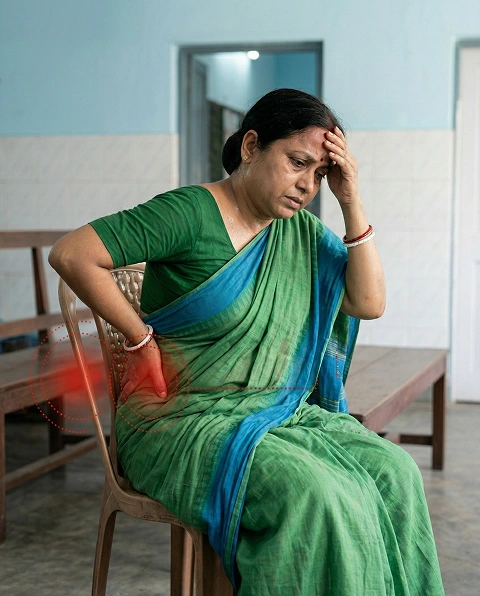
    Fever + Back Pain + Known Stone

    Fever + Back Pain + Known Stone

    Stone + fever = infected obstructed kidney (pyonephrosis) — a urological emergency. Requires immediate drainage BEFORE any PCNL. PCNL must never be performed on an infected kidney — urosepsis risk is life-threatening. Call immediately.
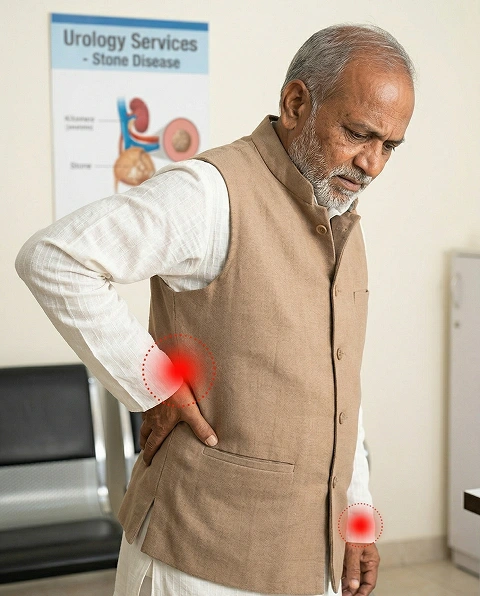
    Worsening Kidney Function with Stone

    Worsening Kidney Function with Stone

    Rising creatinine in a patient with a known large kidney stone indicates obstructive nephropathy — the stone is damaging the kidney. Urgent drainage and stone treatment required. Every week of obstruction causes measurable, potentially permanent loss of kidney function.
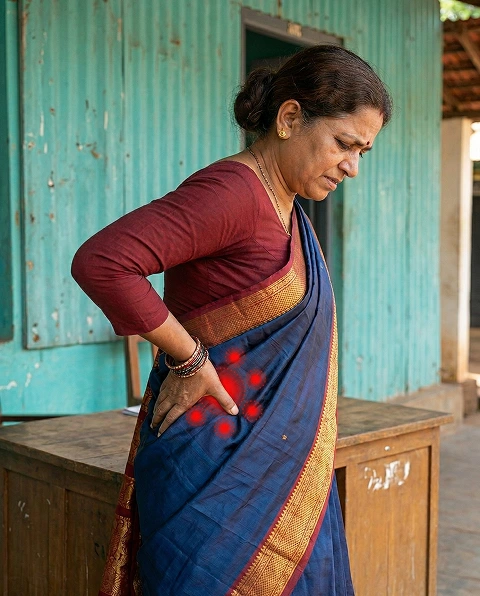
    Dull Loin / Flank Ache

    Dull Loin / Flank Ache

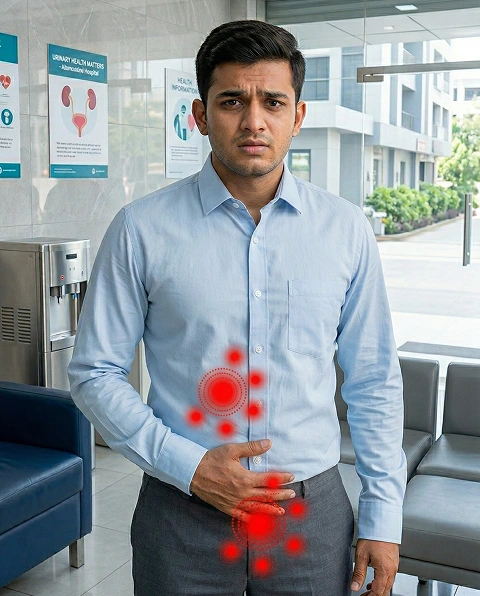
    Large kidney stones in the renal pelvis often cause a constant dull ache or heaviness in the loin from partial obstruction. Less dramatic than ureteric colic but persistent. Requires treatment planning — does not mean the stone is safe to observe indefinitely.
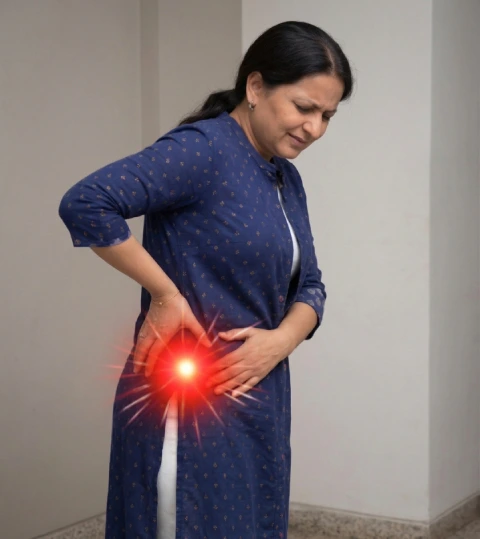
    Pain on One Side Only

    Recurrent Urinary Infections

    Recurrent UTI with a known kidney stone — the stone harbours bacteria that antibiotics cannot eradicate without stone removal. Struvite (infection) stones grow rapidly and are formed by urea-splitting organisms. The stone must be removed to break the infection-stone cycle.
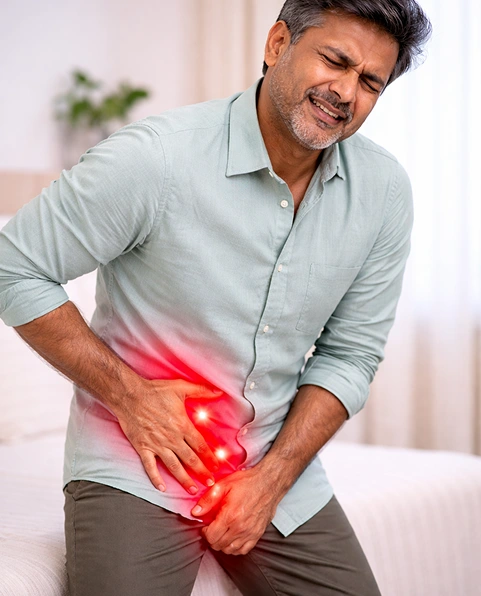
    Asymptomatic Stone Over 2cm

    Asymptomatic Stone Over 2cm

    A large stone found incidentally with no symptoms is not safe to watch indefinitely. It causes progressive renal pelvis dilation, silent kidney function loss and is at risk of sudden complete obstruction with infection. A stone over 2cm needs a treatment plan — not indefinite observation.
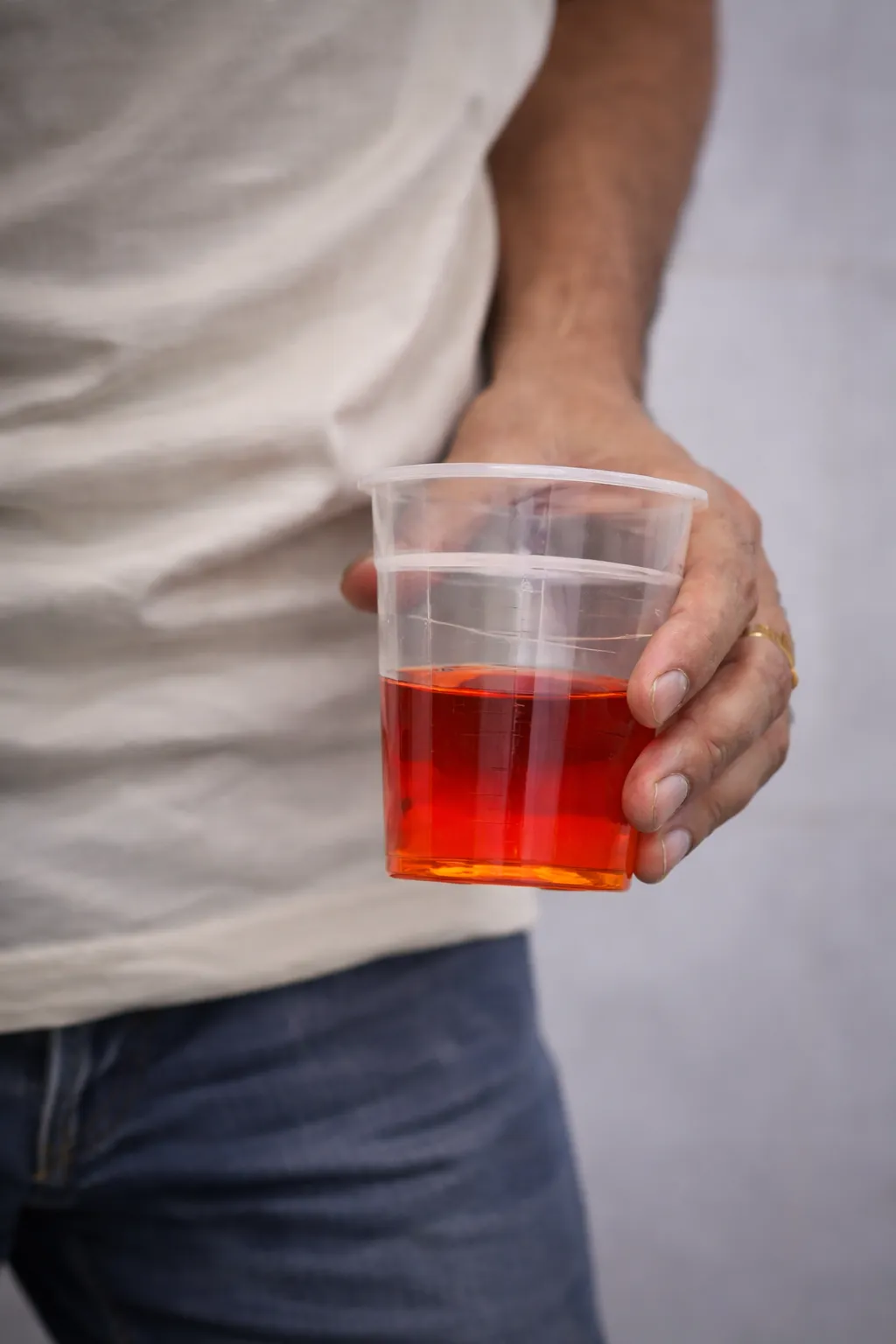
    Blood in Urine (Haematuria)

    Blood in Urine (Haematuria)

    Visible or microscopic blood in urine — the stone scraping the collecting system. Present in the majority of large kidney stone cases. Always requires urine cytology and imaging to confirm stone as the cause and exclude other pathology.
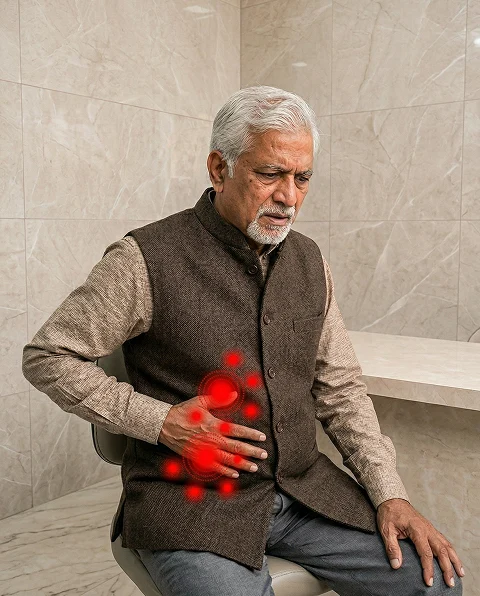
    Stone Regrown After Previous Treatment

    Stone Regrown After Previous Treatment

    Patient with prior ESWL, URS or open stone surgery presenting with recurrence. Residual fragments from prior treatment serve as a nidus for new stone growth. CT KUB maps the current burden accurately — often revealing a larger stone than the ultrasound suggested.
    Hydronephrosis on Ultrasound

    Hydronephrosis on Ultrasound

    Hydronephrosis (dilated kidney) detected on routine ultrasound in a patient with a known large stone indicates significant obstruction. Even without pain, obstructive hydronephrosis causes progressive kidney damage. A MAG3 renogram quantifies the degree of functional impairment.

    PCNL Techniques

    PCNL Surgery — Technique Matched to Your Stone

    All PCNL variants achieve the same goal — complete stone clearance. Smaller tracts reduce bleeding and recovery time. The right technique is chosen based on stone size, calyceal anatomy and the patient's overall fitness.

    Standard PCNL (24–30 Fr Tract)

    Very large or staghorn stones — maximum clearance

    Standard PCNL uses a 24–30 French working tract (8–10mm). Ideal for stones over 3cm, staghorn calculi, multiple calyceal stones and high stone burden requiring rapid fragment removal. Pneumatic lithotripter or high-power Holmium laser fragments the stone; large fragments extracted with forceps; nephrostomy tube placed. Hospital stay 2–3 days. Stone-free rate 85–95% for large stones.

    Maximum Clearance Staghorn Capable
    Best for: Stones over 3cm, staghorn calculi, multiple calyceal stones, high stone burden

    Mini-PCNL (14–20 Fr Tract)

    Stones 1.5–3cm — same result, less bleeding

    Mini-PCNL uses a 14–20 French tract (5–7mm) — equivalent stone-free rates to standard PCNL for stones 1.5–3cm with less bleeding, less post-operative pain and faster recovery, as seen in modern PCNL kidney stone surgery. Mini-nephroscope with Holmium laser provides excellent fragmentation. Nephrostomy tube or tubeless exit. Hospital stay 1–2 days.

    Less Bleeding Faster Recovery
    Best for: Stones 1.5–3cm in accessible calyceal position

    Ultra-Mini PCNL (11–13 Fr Tract)

    Minimal access — selected stones and paediatric

    Ultra-mini PCNL uses an 11–13 French tract (approximately 4mm). Excellent for stones 1–2cm, paediatric patients and patients where minimising bleeding risk is critical (solitary kidney). Fragments vacuumed out through the sheath. Day-care or overnight in selected cases. Longer operative time for high stone burden.

    Minimal Access Paediatric Suitable
    Best for: Stones 1–2cm, paediatric PCNL, patients requiring minimal bleeding risk

    Staged PCNL for Staghorn Calculi

    Two sessions when single-session clearance is not safe

    Very large staghorn calculi may require staged PCNL — first session clears the bulk of the stone; second session 4–6 weeks later addresses residual stone through the same or a new tract. Staging reduces operative time, radiation exposure and fluid absorption risk. Stone-free rates for staghorn calculi after staged PCNL exceed 80%.

    Two Sessions 80%+ Staghorn Clearance
    Best for: Very large staghorn calculi requiring prolonged access or multiple calyceal punctures

    Holmium Laser Fragmentation

    Effective on all stone types — dusting or fragmentation

    The Holmium:YAG laser is effective on every stone composition — including the hardest calcium oxalate monohydrate and cystine stones. Dusting mode reduces stones to fine powder that passes spontaneously. Fragmentation mode creates small retrievable pieces. Combined with nephroscopic vision, Holmium laser achieves the highest single-session stone-free rates of any energy source used in PCNL.

    All Stone Types Dusting Mode
    Best for: All PCNL stone fragmentation — highest stone-free rate, effective on hardest compositions

    Holmium Laser Fragmentation

    Effective on all stone types — dusting or fragmentation

    The Holmium:YAG laser is effective on every stone composition — including the hardest calcium oxalate monohydrate and cystine stones. Dusting mode reduces stones to fine powder that passes spontaneously. Fragmentation mode creates small retrievable pieces. Combined with nephroscopic vision, Holmium laser achieves the highest single-session stone-free rates of any energy source used in PCNL.

    All Stone Types Dusting Mode
    Best for: All PCNL stone fragmentation — highest stone-free rate, effective on hardest compositions
    Why Trayam PCNL

    Leading PCNL Surgery in Ahmedabad for Large Kidney Stones

    PCNL surgery in Ahmedabad depends on surgical experience, pre-operative preparation and the right equipment, with all three playing an equally critical role in outcomes.

    85–95%
    Stone-Free Rate
    Mini
    PCNL Available
    Sterile
    Urine Before Every Case
    Post-Op
    Metabolic Evaluation

    Standard, Mini & Ultra-Mini — All Available

    We offer the full range of PCNL tract sizes and select the appropriate technique for each patient based on stone size, calyceal anatomy and clinical factors. Smallest effective tract when anatomy allows, standard access when stone burden demands it.

    Holmium Laser — Effective on All Stone Types

    Holmium:YAG laser is used in all our PCNL procedures — effective on every stone composition including the hardest calcium oxalate monohydrate and cystine stones. Dusting mode eliminates the need to retrieve multiple fragments, improving stone-free rates and reducing operative time.

    Sterile Urine Before Every PCNL — Non-Negotiable

    PCNL on an infected kidney causes life-threatening urosepsis. Every patient has a urine culture within 2 weeks of surgery — any infection is treated and a repeat culture confirms sterility before proceeding. This is the most important preventable complication in PCNL and we never compromise on it.

    CT KUB — Complete Stone Anatomy Before Access

    Every PCNL patient has a pre-operative CT KUB — stone location, calyceal anatomy, stone density, relationship to adjacent organs and the optimal access point are planned in advance. Inadequately planned renal access is the commonest cause of tract-related complications.

    Stone Analysis & Metabolic Prevention Plan

    Every stone fragment from PCNL is sent for composition analysis. Metabolic evaluation at 6–8 weeks identifies the cause of stone formation and guides a personalised prevention plan. We treat the stone — and its cause.

    PMJAY / Insurance — Fully Covered

    PCNL is covered by PMJAY and all major Indian health insurance policies. Trayam Hospital is empanelled with all major insurers. Our team manages cashless pre-authorisation, admission paperwork and complete claim support.

    Expert Care

    Meet Your PCNL Specialist

    Dr. Renish Patel — Trayam Hospital
    MCh Urology PCNL Expert Mini-PCNL Holmium Laser 10+ Yrs Exp

    Dr. Renish Patel

    Senior Consultant Urologist — Endourology & PCNL Specialist, Trayam Hospital

    Dr. Renish Patel has performed over 2,000 PCNL procedures — including standard, mini and ultra-mini PCNL for stones ranging from 2cm single calculi to complex complete staghorn calculi. The approach: map the stone completely with CT, confirm sterile urine before entering the kidney, choose the smallest effective tract size and always complete metabolic evaluation to prevent the next stone.

    • MCh Urology
    • Endourology & PCNL Fellowship
    • Mini and Ultra-Mini PCNL Advanced Training
    • Published outcomes in mini-PCNL and staghorn calculus management
    • Speaker — Urological Society of India Endourology Meetings
    Common Problems in Large Stone Management

    Stone Over 2cm — Repeated ESWL Sessions With No PCNL Ever Discussed?

    Large kidney stones are frequently mismanaged — either by repeated ESWL sessions that achieve incomplete clearance, or by deferring treatment because the stone is "not causing pain." Both approaches have real consequences: repeated ESWL accumulates radiation and fails to clear the stone, while an asymptomatic large stone silently damages kidney function and sets the stage for sudden obstruction with infection.

    • Stone over 2cm treated with ESWL alone — multiple sessions, still not clear — ESWL stone-free rates for stones over 2cm are 40–60%, declining further for lower pole and hard stones. After two failed ESWL sessions, PCNL should be discussed. Continuing ESWL beyond this point accumulates radiation, bruises the kidney and delays the procedure that would have cleared the stone in a single session.
    • Asymptomatic large stone "being watched" — large asymptomatic kidney stones are not safe to ignore indefinitely. They cause progressive renal pelvis dilation, silent loss of kidney function and sudden complete obstruction without warning — often with infection. A stone over 2cm needs a treatment plan, not indefinite observation.
    • PCNL performed with a positive urine culture — proceeding to PCNL with an untreated urinary infection causes systemic sepsis that can be fatal. Every patient must have a urine culture within 2 weeks of PCNL, and the culture must be sterile before surgery. Operating on an infected kidney is an unacceptable risk that is entirely preventable.
    • No stone composition analysis or metabolic evaluation after PCNL — removing the stone without investigating why it formed means the next stone will form without any preventive measures. Stone composition analysis and 24-hour urine evaluation after every PCNL is standard of care — yet is skipped at many centres. Without it, recurrence rates remain 50% at 10 years.
    The Trayam PCNL Promise CT mapping before every access. Sterile urine confirmed before every procedure. Smallest effective tract size. Stone composition analysis and metabolic evaluation after every case — always.

    CT KUB and Sterile Urine — Before Every Case

    No PCNL at Trayam proceeds without a pre-operative CT KUB and a sterile urine culture. These two steps prevent the most serious PCNL complications — wrong access and life-threatening urosepsis.

    Right Tract Size for Your Stone

    Mini-PCNL when anatomy and stone size allow — standard PCNL when stone burden demands it. We do not perform standard PCNL when mini is appropriate. The technique is chosen for the patient, not convenience.

    Metabolic Evaluation — Prevent the Next Stone

    Every PCNL patient receives stone composition analysis and metabolic evaluation at 6–8 weeks. A personalised prevention plan reduces recurrence from 50% to under 15%. Removing the stone without addressing its cause is only half the job.

    Large kidney stone? Staghorn calculus? ESWL not working? — Bring your CT or ultrasound report — or we start with a CT KUB. We’ll tell you exactly what technique gives the best result for your stone.

    Confidential  ·  No Obligation  ·  Reply in 2 Hours

    After PCNL — Recovery & Prevention

    Recovery After PCNL & Preventing the Next Stone

    PCNL recovery is faster than most patients expect — most go home in 2–3 days. The more important work begins after discharge: preventing the next stone.

    Day 1–2 — Nephrostomy Removal & Discharge

    Nephrostomy tube removed day 1–2 after confirming adequate drainage with no significant bleeding. Once the tube site is sealed and the patient voids comfortably, discharge is arranged. A JJ stent may remain 2–4 weeks if there was significant ureteral oedema — removed as a brief outpatient procedure.

    🏥 Home day 2–3 most patients

    Week 1–2 — Rest and Hydration

    Expect mild back ache at the nephrostomy site for 1–2 weeks, pink-tinged urine for several days and some fatigue. Drink 2.5–3 litres of water daily — high fluid flushes residual stone dust and reduces infection risk. Avoid heavy lifting for 3–4 weeks. Desk work at 7–10 days.

    💧 2.5L water daily from day 1

    4–6 Weeks — CT KUB to Confirm Stone-Free

    CT KUB or KUB X-ray at 4–6 weeks confirms complete clearance. Residual fragments over 4mm may need a further procedure. Confirming stone-free status early allows treatment of any residual fragment before it grows or causes obstruction.

    🔍 Confirm stone-free at 6 weeks

    6–8 Weeks — Metabolic Evaluation

    24-hour urine collection and blood tests at 6–8 weeks identify the metabolic cause. Results guide specific dietary advice, hydration targets and medication. Potassium citrate for hypocitraturia, allopurinol for hyperuricosuria, thiazides for hypercalciuria. Reduces recurrence from 50% to under 15%.

    🔬 Book metabolic evaluation at 6 weeks

    Lifelong — 2.5 Litres Daily

    High fluid intake is the single most effective long-term stone prevention measure. Aim for pale yellow urine throughout the day. 2.5 litres in temperate climates, 3 litres in Indian summer heat. This alone reduces recurrence by 40–50%.

    💧 Pale yellow urine = low stone risk

    Diet Matched to Stone Type

    Calcium oxalate stones — reduce high-oxalate foods (spinach, nuts, chocolate, tea), maintain normal calcium intake. Uric acid stones — reduce red meat and organ meat, limit alcohol, alkalinise urine with potassium citrate. Struvite stones — treat underlying infection permanently. Stone composition analysis from your PCNL specimen guides the specific advice.

    🥗 Stone type determines your diet plan
    Patient Stories

    What Our PCNL Patients Say

    Stone-Free After 3 Failed ESWL Sessions
    "I had three ESWL sessions over 8 months for a 2.8cm lower pole stone. After the third the stone was still there. My urologist suggested a fourth ESWL. At Trayam, Dr. Renish Patel reviewed my CT and told me mini-PCNL would clear this in one sitting. The procedure took under an hour, I went home on day 2 and my CT at 6 weeks was completely clear. I wish I had come here after the first ESWL failed."
    Sureshbhai V.
    2.8cm Lower Pole Stone · 3 Failed ESWL · Mini-PCNL · Stone-Free · Ahmedabad
    Staghorn Calculus — Cleared in 2 Sessions
    "I had a complete staghorn stone filling my right kidney. Two other hospitals told me nothing could be done without open surgery. At Trayam, Dr. Renish Patel performed two PCNL sessions four weeks apart. After the second, my CT showed the kidney was completely clear. No open surgery, 3 days in hospital each time, back at work in 2 weeks."
    Bhaveshbhai K.
    Complete Staghorn Calculus · Staged Standard PCNL × 2 · Stone-Free · Surat
    No Recurrence — 2 Years on Prevention Plan
    "I had two kidney stones treated in three years. After my PCNL at Trayam, the metabolic evaluation found I had high urinary oxalate from eating large amounts of spinach and nuts daily. Dietary changes and potassium citrate. Two years later — no new stone on my annual scan. Nobody had ever done this test after my first two treatments."
    Nilamben R.
    Recurrent Calcium Oxalate Stones · PCNL + Metabolic Evaluation · No Recurrence · Vadodara
    Common Questions

    Frequently Asked Questions

    PCNL is recommended for stones over 2cm, staghorn calculi, lower pole stones over 1.5cm and stones that have failed ESWL. Stone-free rate 85–95% in a single session — far superior to ESWL for stones of this size.

    Standard (8–10mm) for very large or staghorn stones. Mini (5–7mm) for stones 1.5–3cm — less bleeding, faster recovery, equivalent stone-free rate. Ultra-mini (4mm) for stones 1–2cm and paediatric patients. Smallest effective tract chosen for each patient.

    Yes — well established with excellent safety when performed by experienced surgeons. Significant bleeding in 1–3%, sepsis in 1–2% (prevented by sterile pre-operative urine). Minor complications resolve with conservative management.

    Standard and mini-PCNL — 2–3 days. Nephrostomy removed day 1–2. Return to desk work at 7–10 days, physical work at 3–4 weeks.

    A branching stone filling the renal pelvis and calyces — cannot be treated with ESWL or URS alone. PCNL (often staged) is the treatment of choice. Untreated staghorn calculi cause irreversible kidney damage and kidney failure.

    Yes — with extra precautions: meticulous haemostasis, careful fluid management, intensive post-operative monitoring. Complete clearance is even more critical in a solitary kidney.

    Without preventive measures — 50% recurrence at 10 years. With metabolic evaluation and a personalised prevention plan — under 15%. This evaluation is offered to every PCNL patient at Trayam.

    ESWL — no anaesthesia, outpatient, 40–60% stone-free for stones over 2cm, multiple sessions often needed. PCNL — general anaesthesia, 2–3 day stay, 85–95% stone-free in one session. PCNL is the better single-procedure option for stones over 2cm.

    Yes — covered by PMJAY and all major Indian health insurance policies. Trayam is empanelled with all major insurers. Our team manages cashless pre-authorisation and complete claim support.

    CT KUB, sterile urine culture, blood tests, anaesthesia assessment. Positive urine culture means surgery is deferred until infection is treated and repeat culture is negative. Sterile urine is non-negotiable before every PCNL.

    Large Kidney Stone? Staghorn Calculus? ESWL Not Working? PCNL Clears It in One Session.

    Bring your CT or ultrasound report — or we start with a CT KUB. Complete stone mapping, right technique for your stone, metabolic evaluation to prevent the next one.

    Chat on WhatsApp